






I don't generally commend really long articles here, since part of the nature of blogging is to be as short and concise as possible (without being too short, of course). But at the request of my pastor, I just finished reading this article from a site called worldviewtimes.com. Be forewarned: it's a tad long, but worth the read. Ideally, read it before you read my thoughts, please ...
First things first: what Carl (the author) is talking about is plainly emergenT church. He makes some effort to codify this in both the intro and end of his article, but I'm not sure he's adequately made that distinction. To help clarify, I found a chart plotting the spectrum of Emergence (originally posted by C Michael Patton; copied from David Herrick). 
[Please note: I've modified this chart a bit from the original creator's version]
The article in question, then, is clearly dealing with the fading edge of Historic Orthodoxy. I'm not trying to minimize the contentions that Carl makes in his article; I'm attempting to place them in the proper theological landscape.
Onward...
It's difficult to argue with Carl's basic contentions. He's condensed some of the essential differences between Emergent and Emerging (or emerging-friendly, like me). I particularly appreciated his point (near the bottom) concerning how Jesus is central to the "authority" of the Emergent movement. He's nailed it. Emergent folk have attempted to build an ecclesiology around the person of Jesus. As I've pointed out before (here and here), this simply will not do.
As Carl, I've been noticing a consistent trend away from Biblical authority, and particularly away from sola Scriptura. I had hoped to see this trend curtailed, but that does not seem to be the case thus far. The good news is that many voices are developing in the Emerging movement that refuse to go down that road. For my part, I appreciate men like Scot McKnight and Dan Kimball, though I may not agree with some of the things they say.
I'm glad that Carl makes clear that Emerging/Emergent folk have made (and continue to make) some very valid criticisms. I'm afraid Carl has understated some of those, but I'm glad he's acknowledging them. As I've said many times, one cannot understand the phenomenon known as Emerging without wrestling with at least two major issues: postmodernity and the rise of the mega-church. To explore this contention is beyond the scope of this post, though...
If reading Carl's article lit a fire under you, stoking your fervor to defend the Word of God against those that would minimize or even trivialize it, I say "Amen". If it's piqued your curiosity about the Emerging/Emergent phenomenon, I'd encourage you to use the search feature on this blog's home page to poke around a bit. I'm not a fount of knowledge on the subject, but the last several years of posts should provide a good starting point to your inquiry.
Hatushili
Saturday, February 13, 2010
Emergent Criticism

Monday, February 9, 2009
Words written in red
One of the more curious tendencies of the emerging church is to take the words of Jesus as somehow more important than the rest of the Bible. Reverence for Jesus has to be demonstrated by elevating His words to a higher plateau, I suppose the thinking goes. I've seen this attitude in scholarly works on EC and at the local level. It's problematic, and I know I've posted about it before, but for the benefit of a friend let's address the issue again for just a bit, eh?
First things first - the Bible explicitly tells us that all Scripture is given by inspiration and all Scripture is profitable for growth in Christian character. You'd like to think that would settle it, but apparently it doesn't for plenty of EC folk.
Perhaps more to the point, Jesus Himself clearly sees enormous value in the Old Testament Scriptures. In fact, He uses the text of Jonah to validate His own ministry. In Matthew 12, His detractors ask for "a sign" and He promises to validate His ministry by none other than the "sign of Jonah". The language of the text makes it clear that Jesus fully accepts both the authenticity and authority of this OT text. If Jesus Himself had such a high view of Scripture, is it not the height of folly to declare that Jesus' words are more important than other Scriptures?!
Here's another issue: the words of Jesus fail to address so many issues that other texts of Scripture deal with. If we are to limit ourselves to only the words of Jesus, we severely limit God's voice on many, many topics.
Another: seeing the words of Jesus this way is a fundamental error in our view of Scripture. If Scripture is a sort of divine self-help book, then perhaps you could argue that the "way of Jesus" is most important in the Bible. But since the Bible is, in fact, God's self-revelation to humanity, such a view of Jesus' words falls very short of adequate.
None of this, of course, means that I'm devaluing the words of Jesus. I'm simply arguing that - while it sounds terribly pious - regarding Jesus' words as somehow more important than other words of the Bible is actually a lower view of Scripture and therefore the Christ of Scripture, too.
Hatushili
Saturday, November 22, 2008
The Voice, part 2
As I wrote about here, it seems that my emerging friends have a new Bible translation on the market. Aside from the fact that the very last thing I think we need is yet another Bible translation, I have a problem...
I strolled over to the website recently [note: it works better in IE, sorry!] and found a side-by-side comparison chart of the Voice with three other translations (the Message, the ESV and the TNIV). One of the passages they chose for comparison was Jesus' temptation in the wilderness. The NET (which, not incidentally, I really like) reads this way:
"Then Jesus was led by the Spirit into the wilderness to be tempted by the devil. After he fasted forty days and forty nights he was famished. The tempter came and said to him..." Matt 4:1-3a
Fair enough; a fine translation.
The Voice reads this way:
"The Spirit then led Jesus into the desert to be tempted by the devil. Jesus fasted for 40 days and 40 nights. After this fast, He was, as you can imagine, hungry. But He was also curiously stronger because of His fast. And so He was able to withstand the devil, the tempter, when he came to Jesus."
Houston, we have a problem. I'm okay with the concept of dynamic equivalency. I'm okay with a Bible inserting explanatory information within the body of the text, to a point. But did you notice the huge running commentary inserted into the Voice?! To their credit, it's italicized (the oft misunderstood standard for this kind of translational work). But that's little solace to a guy like me that feels the reader - not the editors of a particular translation - should bear the primary responsibility for interpretation.
Who's to say that Jesus' strength was "curious"? Why does the translation call for the quaint little insertion "as you can imagine"? How do we know that it was "because of his fast" that He was strong? What's the value of a comparative (strongerer) when it comes to Jesus?
These and more questions are raised by the Voice's translation. As a rule, any translation that raises more questions than it answers should be viewed with skepticism, no?
So while I've read precisely two passages from this new translation now, I'm very skeptical at this point.
What say you?
Hatushili
Saturday, September 6, 2008
Stuck on Ooze
I pretty much can't stand the theology of guys like Spencer Burke. Yet I find myself routinely reading posts on The Ooze. Why? Part of the answer, I suppose, is that I enjoy a good laugh now and then - some of the arguments made on that site are so ludicrous as to be laughable!
But I find some gems now and then, too. Seriously. I hate to admit it, but once in a while the Ooze really does post something challenging. Usually not; once in a while.
Today's reading of The Ooze is a case study in this truth. This article is utterly ridiculous; this one is actually good.
If you don't read the Ooze, I would encourage you to do so now and again. But keep in mind that you'll need the ability to sift through a lot of garbage to get to the good.
Hatushili
Thursday, June 5, 2008
The Voice
The details are a bit fuzzy for me right now, but it appears that the emergent crowd is soon to have a Bible specifically marketed to them.
Or not?
I'm still doing the research, and I'll leave you to do the same.
Check out The Voice. Poke around a bit and let me know what your impressions are.
As I discover more, I'll post it.
Hatushili
Friday, April 4, 2008
Charting the change
One of the very first books I ever read that could be said to be in the "emerging church" crowd was Robert Webber's The Younger Evangelicals. At the time I read it, I didn't really realize that this work would turn out to be on of the cornerstones in missional (and, for many, emerging) thought.
The folks over at Resonate have taken the time to publish one of Webber's comparison charts from the book. I found it fascinating when I first read it, and even more so now. I discuss it here in the hopes that it might prove useful to you...
Here's the link to the chart. Spend a little time reading over it and let me know what you think.
One of the more interesting features of the chart to me: the final column (Younger Evangelicals) is what most mirrors emerging and/or missional folk today, and I find that much of that thinking is a reaction more to the middle column than the first. Certainly no one in either the missional or the emerging church movement would advocate much of the first column! But at least to me it seems the primary reaction is to the middle... What do you think?
Incidentally, as you might expect, I find myself much more in agreement with the last column than any other. I have some agreement with column number one here or there, but I can't really see anything in the middle column I find appealing... How about you?
Hatushili
Saturday, February 9, 2008
Divine humor
Thanks to new reader Buttons for turning me on to this site. Consider it the Christian equivalent to The Onion. I've only just begun to poke around the site, but have found it laugh-out-loud funny thus far. One that's particularly good:
---
Emerging Church Explores Christology of SpongeBob Squarepants
Pastor Doug Pagitt of Solomon’s Porch slammed the yellow and brown markers onto the whiteboard tray and strutted back to the microphone. “It’s totally obvious. The world that God so loved, for whom Christ died, really is symbolized by that pineapple under the sea.”
More than five hundred leaders from the emerging church conversation gathered last weekend in Earlimart, Calif. to discuss Biblical typology found in the popular cartoon SpongeBob Squarepants.
Author and speaker Spencer Burke was emphatic in his rebuttal to Pagitt. “The proper postmodern hermeneutic, one that gives great space for the meta-narrative, leads us to conclude that the world is typified by Bikini Bottom,” Burke said. “Can’t you see that, Doug? The pineapple under the sea is a symbol of our Father’s house, where Jesus is preparing a place for us.”
Though sharp disagreements arose over which people in the Bible were represented by Squidward Tentacles and Mr. Krabs, most attendees agreed that Patrick Star is a spot-on Simon Peter.
---
Happy Reading,
Hatushili
Tuesday, January 22, 2008
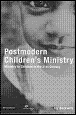
Book Review: Postmodern Children's Ministry
If you search around for books on Children's Ministry from a postmodern perspective, you'll soon be disappointed. There aren't a whole lot of choices. But Ivy Beckwith's Postmodern Children's Ministry usually comes to the top of this short list of choices. She is unashamedly postmodern and an emerging church advocate. For these reasons, I felt her book should be on my reading list.
I just finished it, and found it an exercise in frustration. One minute I'd be loving every word she wrote; the next I found myself laughing at the inconsistencies and folly of other concepts...
Her first chapter is a fine synopsis of what most of us mean by "cultural Postmodernity". In particular, she discusses the impact that this worldview is having on children and the need for changing our methods and ways of thinking with regard to CM. The book started out on a very good note, in my opinion.
Chapter 2 lost me a bit. In this chapter, our self-stated postmodern turns to and leans heavily on (apparently) decidedly Modern sociologists. She walks us through the theoretical stages of childhood development and faith development. While there is surely merit in some of these theories and they deserve to be considered, I found it fascinating that the same author who will (in a later chapter) embrace the notion that all truth is dependent upon context and community is in this chapter so sure that these psycho-social principles are valid. Not awful; not particularly awe inspiring.
I found Chapter 3 more valuable. Here the author talks about (among other things) the folly of insisting our children grow up so fast and the unBiblical notion that children must be groomed for the best paying job possible. She talks about focusing on their spiritual development as much or more than their academic development. In particular, I love this quote:
"Spiritually forming children means we help them see that in the economy of the kingdom of God being successful is loving others, showing mercy, fighting for justice, and walking humbly with God."
Though she doesn't specifically reference Micah or any of the other Minor Prophets, this concept is draw directly from them. We would all do well to remember this. In this age when the ultimate goal of most parents is to see their children graduate from college and get a "good job" it is the duty of pastors and other concerned folk to remind these parents of their truly God-given responsibilities and to challenge them to be about the business of spiritually forming (read: discipling) their children.
Chapter 4 is a short but good reminder of the value of community. Children are much more likely to remember the relationships they had as small children than to remember any specific Sunday School lessons. Children are as much a part of community as any adult.
Chapter 5 takes the concept of community and addresses children specifically. There are some good thoughts in this chapter, but for the most part I found it frustrating. For example, in her discussion of "Citizenship" she completely ignores the very important truth of sheltering and protecting children. It is our God-given responsibility to watch over and guard them, slowly letting up our guard as they begin to develop their own. But for the author, this is tantamount to creating a "Christian ghetto". She finds it frustrating that so many churches want to offer their children alternatives to the godless activities of public schools and local communities. She asserts that children need to learn about being "salt and light".
But at what point are children prepared to be salt and light? Surely we cannot simply cast them to the wolves from their earliest elementary school years, can we? Aren't we charged with watching what they see, hear, experience and regard? While I agree that we cannot foster an "us versus them" mentality with our children, I am not willing to cast my children before the wolves of Satan until they are good and ready!
I appreciated Chapter 6. Here the author focuses on the family - the fundamental unit God first created. She bravely points out that too many well meaning churches have usurped the authority of family over the spiritual formation of their own children. She also discusses how church community naturally emulates family (by being multi-generational and composed of families itself) and suggests that churches would do well to incorporate this truth into their work of discipling children.
Chapter 7. What can I say? I wish Chapter 7 hadn't been written. Here the author discusses the Bible. She talks about how one should and should not read and teach the Bible. Here is where her postmodernity runs amok - "And since we all bring our own stories and our community's story to any reading of the Bible, we all read the Bible subjectively [so far, she's making a valid point]. There is never an objective exegesis or analysis of the biblical text. We'll never know for sure what the original writers of the story were intending to say."
That's an awfully absolute statement to be making, no? It is defeatist, and it underestimates the purpose of God in recording Scripture. Even more frustrating, within the span of just a few pages, the author is talking about the critical importance of understanding the historical and cultural context of a given passage of Scripture, and asking the question "why did God choose to have this passage recorded". It appears she wants to have her postmodern cake and eat it too!
What's good about this discussion is it points out an inherent weakness in postmodern philosophy. Those in the ivory towers tell us that there is no such thing as absolute truth, and those on the cultural ground try to buy into that thinking. But in reality - unless you have a tenured position at a university - no one can really live this way. We all understand that certain things are objectively true. In this case, the author somehow knows that context and culture are absolutely imperative to an understanding of Scripture. She knows this deep within her being, yet she's refusing to acknowledge the implicit truthfulness of her claim. There is great tension where the ivory tower meets the street.
Chapter 8 ended the book on a good note for me. Here the author talks about ways to incorporate children into the weekly worship service of the church. She acknowledges the difficulties, but believes the benefits outweigh the challenges. I think she's right, personally. But whether a church family chooses to always include children in worship or chooses to do so on regular occasions, the choice belongs to the elders of the community of faith. I would simply argue that we must make every effort to help children feel a legitimate, valuable part of the community of faith.
All things considered, I'm glad to have read Beckwith's Postmodern Children's Ministry. Like so many things in life, you take the good and throw out the bad after chewing on it for a while. There are concepts and ideas she shares that need to gain a broader audience. I stand with her in her opposition to what she calls Disney-esque children's "ministry". Parents must be about the business of discipling their children. The community of faith has an obligation to help in any way it can.
Hatushili
Monday, January 21, 2008
Have we really done this poorly?
As you know, I really enjoyed Donald Miller's book Blue Like Jazz, so when I saw my local paper carry a feature story on him I was delighted. It's the anchor article for the "Faith" section of the Sunday paper and also bears an enormous colour picture of Don. [Though not bearing the same picture or title, here's the article from another source.]
What really surprised me about the article (written by an AP writer) was not its existence (Don's been very popular for a while now) but the misunderstanding and partial understanding it propagates...
Start with the article's title: "Redefining Christian". That's an attention getter, for sure! The subtitle expresses the editor's main point - Author [Don] disavows notion that faith is conservatism. I found it very distressing that this newspaper editor felt that Christianity was primarily defined by it's attachment to the Republican party and conservatism in general. Don, of course, wants to dispel that notion among Christ's followers. Sadly, we've obviously been so attached at the hip that the non-believing world has made the connection...
But the emerging church has fared no better in being understood by this AP author. Read this line from his article slowly:
"The book also debuted at a time when the emerging church movement - which emphasizes the individual's faith experience and varied worship styles - is flourishing, signaling a fertile audience for such religious musings among more socially liberal evangelicals."
No mention of postmodernity. No talk about social justice. No word of community.
At least for one AP writer, "emerging church" can be condensed into "individual faith experience and varied worship styles"!
Many of us have long believed that Christ's followers have done a terrible job at proclaiming who we really are, and who Jesus really is. I offer this article as yet another proof that this belief is well founded.
Hatushili
Wednesday, November 21, 2007
Who gets to speak for God? (part 3 of 3)
We started this conversation here, then continued it here, in case you're keeping track.
In those two posts, I basically argued against the two primary intentions behind the question "who gets to speak for God?".
Now (finally!) I'll give some of my own thoughts about the issue...
As I mentioned before, people generally use this question as a way of articulating either a) a leaderless/egalitarian position, or b) overall skepticism about the ability to objectively know what the Bible teaches.
I find both intentions unnecessary, but that doesn't mean I object to the question.
So, in my opinion, who does get to speak for God?
First, we need to remember that each of Christ's followers has the right to read and the empowerment to understand Scripture. The Holy Spirit resident within us makes clear things that the "natural man" cannot grasp. This is one of the truths the Reformers fought so hard for, and we should not readily abandon it. I will never advocate a position that only allows a certain select few to speak for God, whether pastor, teacher, elder or otherwise.
But we can't take that position too far. We must also acknowledge that some people have ability to handle Scripture beyond our own, through training, practice, wisdom, experience, etc... For example, odds are good that a pastor of 25 years will have some significant skill in interpreting Scripture - skill to a degree unlikely to be found in a new Christian. But that same pastor of 25 years has no monopoly on truth! He will have just as many biases and preconceived notions as the rest of us. We need each other - all our voices - to help keep one another honest, to gently expose our biases, to gain a deeper sense of perspective.
Those in the life of the local church accustomed to speaking for God (read: pastors, preachers, elders, SS teachers, etc...) need to carefully avoid giving the impression that they have exclusive right to full knowledge. We must be willing to admit just how humble our level of understanding really is. When necessary, we must be willing to agree to disagree.
But yet we cannot escape the genuine authority structures that the Bible lays out for us. Elders have a God-given responsibility to guard the flock against wolves. And trust me, there are plenty of wolves out there - cults, 'isms, heresies, and downright demonic schemes. Elders - especially those that are paid to serve full-time - likely have much more time than others to read and research, to ponder and work through the issues facing us today. In short, they very often have insight and wisdom that we cannot ignore. So, for example, if you want to bring so-and-so's book into your Sunday School class but the elders consider it unwise ... listen to them! Ultimately you retain the right to leave that local assembly - it's the best way people can help keep elders and churches from straying. But so long as you're under the authority of a local church, give serious consideration to the wisdom of its leaders.
Moreover, we are all part of a body - one organism. Therefore it is simply unacceptable to ignore the wise counsel of others, believing that we all "speak for God". It is unhealthy to think of "me" all the time, instead of "us". There's a time and place for "me", but the normal model should be "us".
Take the "worship wars" of the recent past. How much of this would have been avoided by people remembering that the church does not revolve around their personal preferences, but instead heeding the wisdom of the elders and the principles of "us" (not "me")?
I guess more than anything what I'm really calling for is humility.
Elders, teachers, preachers and pastors that humbly recognize their own limitations; that humbly recognize the skills and abilities of others around them; that humbly speak for God as they serve the church.
Congregants that humbly recognize the authority structures within the life of the church; that humbly desire to understand the Word; that humbly speak for God as they collectively do the work of ministry.
Hatushili
Saturday, November 3, 2007
Who gets to speak for God? (part 2 of 3)
[In case you missed part one, you can read it here.]
Last time, we looked at those that use the question "Who gets to speak for God?" as a way to support egalitarianism, or even so-called "leaderless" models of church.
Today we look at other primary way people use this great question...
There are plenty of well-meaning folk out there that use this question as a way of supporting their belief that so much of what we call Biblical interpretation is subjective. They've grown weary of the somewhat silly notion that (for example) Greek and Hebrew language skill can resolve all the difficulties of the Bible! [Believe it or not, I was once in that camp ... 15 semesters of ancient languages later I know better!] They tire of people that think they've got it all figured out. You know the type - no room for mystery, no room for disagreement.
So the question ("who gets to speak for God?") gets raised as a way of reminding everyone that no one has a direct line from the mouth of God, as it were. We're all - like it or not - subject to a certain amount of subjectivity when it comes to interpreting the Bible.
There are those that believe almost everything about the Bible is subjective, but I'm not really addressing those folks in this post. In my experience, they tend not to ask the question we're discussing. Nor do they use the question to prop up their claims. They tend to be much more direct and pointed about their issues...
But for those that genuinely wrestle with the many (seemingly) contradictory or at least "difficult" passages of Scripture, asking this question is a good way of levelling the playing field.
There are two appropriate responses to this situation, in my opinion:
1) We must acknowledge the fundamental truth of what they're saying. There is a fair bit of subjectivity in the human interpretation of Scripture. You don't have to like that fact, but it's a fact nonetheless. That doesn't mean, of course, that we shouldn't study God's Word and seek to come to an understanding of if. What it means is that we must carefully guard against coming to quick or easy conclusions, and we must certainly make every effort to genuinely consider the opinions and interpretations of other Christ-followers when they disagree with ours.
Here's a good way to start. Try to eliminate the only-slightly subtle "I'm right and you're not" language from your vocabulary. For example, avoid phrases like:
Anyone who takes the Bible seriously will agree with me.
That's a pretty liberal interpretation.
Sorry, I just don't buy that interpretation.
In others words, when the debate is in-house let's keep it civil and humble.
2) When appropriate, we need to try to help these people understand Biblical hermeneutics. Know going in that there are different hermeneutical paradigms that people use, and some of them you're just going to have to agree to disagree with. But in my experience, once people see that you hold your interpretations humbly but you hold them for well-considered reasons they are much more likely to feel a peace about the whole process of Biblical interpretation. We can't give the impression that people just make this stuff up! Because that's exactly how it looks to many...
If we believe that God wants us to know His Word, we must believe that He's given guidelines for how to do so. Helping people understand this principle therefore comes with the added bonus of helping them understand the very nature of God better.
---
So, if you're asking "Who gets to speak for God?" because you're frustrated with the know-it-all attitude of too many Christians and what to encourage them toward humility, I'm with you!
But if you're asking the question out of your own doubts and fears, let me help you.
Hatushili
Tuesday, October 16, 2007
Who gets to speak for God? (part 1 of 3)
There is a great question you hear often in emerging circles: Who gets to speak for God? It's a good question, but it's more complicated than it might seem on the surface. I want to go through the two primary ways people use that question - what exactly do they mean, and what point are they trying to make?
Then I'd like to argue for a position somewhere in between the standard emerging mantra (if there truly is such a thing as a "standard" anything in emerging) and the traditional Protestant position. This will be a three-part series, then. So let's begin...
[Before we dive into this, let me just note that I don't pretend to know how everyone uses this question, nor even most. What follows is my general impression of the ways this question is bandied about in emerging circles. I consider myself fairly well-read on the subject, but by no means an expert.]
First, it's important to note that there are two ways people use this great question - who gets to speak for God? In this post we'll examine one:
The Egalitarian/Leaderless position: There are plenty of emerging (and otherwise) folk out there that seem to use this question to argue for either a generally egalitarian position or perhaps even a truly leaderless model. The argument goes something like this: since we're a "kingdom of priests", no one person has the right to speak for God exclusively on any given issue; therefore, we'll not have either a) traditional leadership roles, or b) traditional teaching/preaching formats.
Solomon's Porch is a good example of this. Doug Pagitt (a name you should definitely know in emerging circles) is the pastor there. This is what their website has to say about their "leadership co-op". Notice in particular that the only thing even bordering on a Biblical notion of qualified leadership is (perhaps) in the phrase "Demonstrate leadership consistent with the Biblical and Historical church example". This is a conscious effort on their part to do away with the notion of exclusively male, exclusively elder-based leadership. I'll not insult Doug and make the "he doesn't take the Bible seriously charge" that so many others have levelled at him. But clearly I understand things a little differently than he!
Doug's concept of preaching also falls into this category. He calls traditional preaching "speeching" and is not very fond of it. Instead, he argues for what amounts to an open mic night, guided loosely by the pastor. Again, "who gets to speak for God"? At Solomon's Porch, virtually anyone. What if a bona fide heretic takes the floor? What about a cultist? What about a grossly immature Christian? What about someone with absolutely no understanding of Biblical interpretation?
The answer? Remember - we're a kingdom of priests and therefore all get to speak for God.
The tough part about arguing against this approach is that it is right on some level. We are a holy priesthood - so says 1 Peter 2:5.
But that doesn't necessarily mean that egalitarianism is the more Biblical position, nor does it mean that monologue (traditional preaching) is less desirable than an open mic. The fundamental problem with this version of the "who gets to speak for God" question is that it neglects the many, many passages of Scripture that deal directly with leadership, teaching, preaching, etc... The Bible is very plain that certain people are set apart as leaders of the church. The Bible calls these people elders and lists very specific requirements that they must meet, and lists a number of the responsibilities of elders to the local church, and lists many of the responsibilities of the local church to the elders. We're not working with a lack of data here, folks!
If elders have a responsibility to keep the heretical "wolves" out of the assembly (and they do), how can you justify risking heresy in the name of egalitarianism? How can you brush off this terrible responsibility with a "who gets to speak for God"?
If elders are required to be capable teachers (and they are) and those especially gifted and able at teaching are to be commended (and they are), then how can we justify the "open mic" theory of preaching with a "who gets to speak for God"?
If elders are given a specific list of (probably minimal) requirements (and they are), how can we justify not including these in the discussion of "who gets to speak for God"?
There's something fundamentally American about the basic notion of egalitarianism, isn't there? We are, after all, rugged Individualists. We blaze our own trails, right? We have our rights, after all! As I've argued before, this kind of thinking has little place in the community of Christ's followers.
Having said all that, I'm not arguing for a position that only elders have the right to ever communicate, teach, preach, lead, etc. I'll get to my position after the next post...
Also, please understand that I'm merely using Solomon's Porch as one example. I don't know what goes on in their assembly nearly well enough to say that all of the above is true of them. This isn't about Pagitt; it's about a particular interpretation of "who gets to speak for God".
If you're asking that question in an effort to by-pass or ignore the God-given responsibilities of elders, you're on the wrong track.
Hatushili
PS: Just for JB...
Friday, September 21, 2007
The great Roman Catholic-Emerging conspiracy!

Having recently read and engaged with an article claiming to link Emerging Church with Roman Catholicism, I've had my curiosity piqued: Do others also think this way?
The answer, it appears, is 'yes'. I've found another one. This particular critique is longer and (sometimes) more sensible, but equally as mean-spirited and reactionary. Read it if you like; I'll hit some of the positives and negatives...
On the positive side, this author (Richard Bennett, who is a former Roman Catholic priest) makes a few good points. His article is basically a critique of Brian McLaren's A Generous Orthodoxy, and I share some of his concerns about this very influential book.
For example, Bennett takes issue with McLaren's "God A vs God B" paradigm, noting that "By this fictitious contrast he entices his readers to choose between two highly subjective conceptions of a god of his own imagination". Back in June, I made this observation regarding the same subject:
Chapter 2: Jesus and God B - Here McLaren contends that God should not be seen as merely "'God A', a single, solitary, dominant Power, Mind, or Will, but as 'God B', a unified, eternal, mysterious, relational community/family/society/entity of saving Love" (p.85).
If that isn't terribly confusing enough, there's more: "In English, there just isn't a personal pronoun to express this kind of Life/Personality that isn't either exclusively male or exclusively female. The only nongender pronoun in English is impersonal (it)" (p.83). I especially dislike this quote because it implies to the average reader that such a pronoun exists in the original Greek manuscripts, but not in English. As grammar would have it, though - there is no such pronoun in Greek either!
I found many occasions in this book when McLaren's lack of theological training became obvious. This chapter was one of those.
The truth is that - to use McLaren's somewhat odd language - the God of the Bible is both God A and God B. The Bible clearly paints Him (not It) so.
Also like Bennett, I was deeply troubled by the way McLaren attempts to redefine the old standard TULIP acrostic to better suit his own tastes in theology. Kudos to Bennett for pointing out the foolishness of such an attempt.
But the bad in this article far outweighs the good, folks. Right off the bat, Bennett tries to import a Roman Catholic context to this whole debate, one that is foreign to every discussion I've ever had with emerging-type folk. It comes across as nothing more than a conspiracy theory when he insists that:
Thus rather than looking for unity based on truth, the Papacy, as ever, is seeking to secure visible outward conformity through the compromise of others. This is the larger context into which the Emergent Church is set.
or that:
McLaren is in the early stages of presenting the same protocol as Papal Rome. But then, Rome said that the induction of Protestant churches was to be "little by little" as their thinking was changed by dialogue with Catholics.
Moreover, Mr. Bennett is clearly not very well-versed in the fine art of sarcasm. I know that as a (cultural) postmodern, I have an advantage on this front. But Bennett seems to be completely missing the rampant sarcasm in A Generous Orthodoxy. He actually thinks it's bitterness! For example, quoting McLaren ("you should know that I am horribly unfair in this book, lacking all scholarly objectivity and evenhandedness"), Bennett claims the he "shows by his own admission what amounts to bitterness against his conservative Protestant heritage...". Clearly Bennett doesn't understand the tenor in which McLaren meant these words. Perhaps if he ever read any of McLaren's other works, or listened to him speak, or even familiarized himself with the culturally postmodern context that McLaren runs within... But that's too much effort, I suppose.
Further adventures in missing the point: Bennett takes McLaren to task for saying "But the Bible requires human interpretation, which was a problem [for Reformers]...". To Bennett, this is nothing short of a denial that "Scripture is to be interpreted by Scripture". But that's not the point. The point is which Scriptures? How do they interpret one another? By what method do we come to conclusions? Etc... The point is that the very act of interpretation necessarily involves humans.
And my personal favourite: when speaking of Martin Luther, McLaren (correctly) points out that Luther lived at the beginning of what we now call the Modern era (as opposed to the new Postmodern era). Apparently Bennett is wholly unfamiliar with the actual modern/postmodern debate, as he actually says:
In this way, he [McLaren]is able to use Martin Luther as simply a man of another time, not relevant for today because that time, which he calls modern, is now over.
Did you catch that? Bennett is throwing in the "which he calls modern" bit as a dig! As if McLaren is simply making up these terms to confuse people. I knew a Christian leader once who described postmodernity as a "camp" that he was not in! Much the same here. One more time, folks - modernity and postmodernity are not terms that heretics made up, nor are they "camps" to be in or out of, nor do they inherently carry value judgements. They are merely very common words used to describe a philosophical shift of massive proportions.
---
Mr. Bennett (and others), you may deny the existence of the 40 foot wall of water if you wish. You may insist that it is, in fact, merely a "fad". You may even claim that the word "tsunami" has merely been fabricated by a heretical group. But that does not change the facts.
They are (in case you're taking notes):
1.) Postmodernity has already come.
2.) It will soon be the dominant view within all Western culture (it already is in many areas).
3.) It is not necessarily any better or worse than Modernity; it's just different.
In light of these facts, it is my goal to help craft a cultural Postmodernity that better reflects His glory and that better equips Christ's followers to serve His mission.
Others, it would appear, would prefer to stick their heads in the sand or claim it's nothing but a Roman Catholic conspiracy.
Hatushili
Friday, September 14, 2007
An interesting quiz
Once upon a post, I attempted to come up with some questions to test one's level of comfort with postmodernity. Today I stumbled across a similar, but much broader, attempt. Emergent/Postmodern Evangelical Holiness/Wesleyan Fundamentalist Reformed Evangelical Neo orthodox Charismatic/Pentecostal Classical Liberal Roman Catholic Modern Liberal I was reasonably sure that this was going to be the silliest thing I'd ever read with regard to the emerging church movement. I don't know much about author Anne Rice. I know that she once wrote dark and violent books (most famously, Interview with the Vampire). I know that a while back she became a follower of Jesus and began writing fictional books about the boyhood of Christ. I know that she's (for these and other reasons) quite controversial. [Yes, I know this is my fourth post of the day. I'm catching up on my blog reading!] A common question (for me) came up again the other day, so I thought I might ponder a bit on this post. A few days ago I posted what I liked about McLaren's A Generous Orthodoxy. Today, as promised, I'll talk about those matters where I felt McLaren went seriously adrift of what's proper and/or Biblical...
This quiz attempts to find your "theological worldview". As with any such quiz, many of the questions are subject to interpretation. But they allow you to scale your answers along five points, so there's some wiggle room in there.
I'd encourage you to click the link and take the test yourself - it doesn't take long. Report back on your findings, if you like.
As for mine...
Here are my official results:You scored as Emergent/Postmodern, You are Emergent/Postmodern in your theology. You feel alienated from older forms of church, you don't think they connect to modern culture very well. No one knows the whole truth about God, and we have much to learn from each other, and so learning takes place in dialogue. Evangelism should take place in relationships rather than through crusades and altar-calls. People are interested in spirituality and want to ask questions, so the church should help them to do this. 79% 71% 71% 54% 50% 39% 18% 11% 0%
---
Note that the actual answer page had a picture of Brian McLaren on it ... I felt compelled to remove it.
Also of interest to me: I'm nearly as much "Fundamentalist" as I am "Emergent/Postmodern". I know many don't see how the two can co-exist, but trust me - at least in my own life, they do.
Hatushili
Read More......
Danger: Baptists being coverted to Maryism by Emerging Church!
I was wrong.
How about this: "Emerging Church is leading Protestants back to Rome". Seriously...
If you followed the link, you know it refers to a publication of the GARBC, an organization for which I have at least modest respect. But this is just silly. There are many legitimate concerns surrounding all things Emerging Church, many of which I've documented on this blog. But this is just ridiculous.
Here's a sampling of the article's main points:
a) "Emergent leaders say God’s Word no longer holds the answers to life’s questions."
Really? Which "emergent leaders" say this? The question emerging church people ask is not if the Bible holds life's answers, but how we are to interpret and (more importantly) live these answers.
b) Brian McLaren's A Generous Orthodoxy "rejects the Word of God" because... well, ... because he uses too many labels!
The author actually claims that the reason McLaren uses labels like "post/Protestant" and "Anabaptist/Anglican" to refer to himself is because he rejects the Word of God. He offers no real logic or reason to support this assertion, and one gets the distinct feeling that this author simply could not have actually read A Generous Orthodoxy and come to this conclusion. Surely there are problems with A Generous Orthodoxy, as I've documented here. But this kind of broad brush defamation should be beneath the dignity of a Christ follower.
c) It's bad to enjoy "formal liturgy, the religious rites and a reverence for God".
Here's a classic problem for those who want to see Satan in the Emerging Church. They fail to understand that one can believe in Truth and Experience. Someone in my shoes, when cornered, will claim that Truth leads to Experience. But plenty of other followers of the Son claim that their Experience led them to the Truth. I won't quibble. The fact is that some people can enter into a more full communion with God via things like liturgy, communion, baptism, etc... And some people personally prefer a more "reverent" worship posture. These are grounds to condemn? Really?
---
Also of irritating note: the article quotes McLaren, but doesn't give a citation. I wanted to look up the quote they give and see it in context, but I can't. Also, they mention Robert Webber, but don't mention that he's recently gone home to be with the LORD. I understand that the magazine is just reprinting an article from February (before Dr. Webber died), but common courtesy would usually dictate that an editor add something like [recently deceased], or maybe a footnote, or something! I get the feeling that if the article made mention of someone more "palatable" to the GARBC, such homage would have occurred. But maybe I'm just jaded...
The gentleman the wrote the article was, by his own admission, raised as a Roman Catholic. I'll cut him some slack for that. But to try to make the case that the Emerging Church is actually leading people to convert to Roman Catholicism, and without citing a single case in which it's happened?
It has all the look of a smear and fear campaign to me.
HatushiliMonday, August 20, 2007
Emerging Democrats
Here's another log to add to the fire of controversy: she's voting for Hillary.
That fact is not the point of this post, though...
What I find most fascinating about this whole situation has to do with the statement about this on her website. It's worth reading, regardless of your feelings about her or Hillary.
This section in particular is worth pondering:
Though I deeply respect those who disagree with me, I believe, for a variety of reasons, that the Democratic Party best reflects the values I hold based on the Gospels. Those values are most intensely expressed for me in the Gospel of Matthew, but they are expressed in all the gospels. Those values involve feeding the hungry, giving drink to the thirsty, clothing the naked, visiting those in prison, and above all, loving one’s neighbors and loving one’s enemies.
First, I find it very typical of the emerging movement to say that her Christian values are based upon the Gospel accounts, not the whole Bible. Please note, I have no idea if Anne Rice even knows about the emerging church or not, but this paragraph she wrote could easily have been penned by McLaren or McKnight or otherwise.
It comes down to the "living the life of Jesus" motif so common in emerging circles. A former professor of mine wrote about this over at his blog [you'll have to scroll down to the post entitled "Living the Life of Jesus..."]. While I'm sure that this goal (living as Christ lived) is noble, I'm not sure it's quite the right spin we need on our daily lives. He was, after all, God incarnate. I am not. Moreover, I'm not sure we should be neglecting the other 62 books of the Bible in preferential treatment for the four Gospels.
Also interesting in Anne's paragraph: she thinks the Democrat Party is better able to address the social justice concerns that she carries as a Christian. But let's back up a step or two. Do you believe that the best way to act upon these concerns is through the auspices of the federal government? Let me put it another (more loaded) way: As a follower of Christ, am I willing to let the church off the hook on social issues and say our main/only responsibility is to merely pay the appropriate tax? I guess I'm just not that trusting of bureaucracy...
So I guess this is another reason why I'll call myself emerging-friendly, but not emerging: I'm persuaded that Christ's followers must address the very real social justice issues facing our communities, but I'm not personally persuaded that the government is the best way to do so. Let's roll up our sleeves and get dirty, not just send off our tax check.
It's rather like missions, in a way. It's much easier for people to send money to overseas missions than it is for them to engage their own community with the Gospel of Jesus Christ. For some (not all), I fear that sending money overseas is a way of relieving guilt. In perhaps the same way, it's much easier to get "outraged" about poverty (for example) and feel better about yourself by voting for the party that will try to tax the situation away than to actually (again, for example) volunteer at a soup kitchen or give money directly to the local food bank.
Anyway, Anne is to be commended for recognizing that politics and religion not only can, but must mix. I just disagree with her as to how.
HatushiliSaturday, August 11, 2007
What a broad brush with which you paint!
I just found an article so outlandish that it's almost funny. Except that the guy is serious. I'll cut him a little slack - there are people within the emerging church that fit his description. But to say Al-Qaeda Supports the Emergent Church!?!
This is the same kind of whiny, lack of understanding, bomb-throwing that people on the other side of the aisle are routinely accused of (and rightly so, often). God forbid we should actually try to understand a Christian movement before we declare it anathema! Both sides (traditional Fundamentalists and emerging/missional types) could learn a thing or two about constructive criticism, eh?
HatushiliSaturday, August 4, 2007
More thoughts on Hermeneutics

As I've said before, the issue of hermeneutics (principles for Bible interpretation) is one over which I often part company with my emerging church friends. For those of you interested, I thought I'd discuss the two main (broad brush) methods of interpreting the Bible on the landscape right now. If you've ever wondered why some people interpret the Bible so very differently than others, this post will help you begin to create a framework for answering that question...
There are lots and lots of hermeneutical systems out there; I don't want to give the impression that there are only two. But in general terms, the systems out there can be classified in one of two ways:
Reader Response: This basic system of interpreting the Bible states that what is important in a given passage of Scripture is what the text means/says to you. That is, the response of the present-day reader is what is most important. This is not the same as asking the "how does this verse apply to my life" question. This is a system that believes the message of the Word of God will necessarily vary from reader to reader; God uses His power to guide each individual reader of Scripture to their individual interpretation. So an adherent of this system will freely allow that verse A can mean X to one person and Y to another and Z to a third, etc... Sometimes these different "meanings" can even be contradictory, or at least appear to be.
Here's a good example. I read a blog post recently defending the position that women can serve as pastors. This lady (a female pastor) made several points supporting her position, then came to the issue of Paul's view based upon his New Testament writings. She writes, "You know, I had the classes in seminary on the 'texts of terror' so often used to keep women from leadership in the church. Paul takes both sides of the issue, depending on where you look."
I presume that most people realize this is a logical impossibility. [Man, do I sound terribly Modern!] From my vantage point, it's simply not possible that Paul simultaneously believed that woman both can and cannot serve as pastors. He had to hold one view or the other, right? Or perhaps some third view. But he couldn't have held those two contradictory views at the same time, not if he was rational.
Reader response theory has little trouble rectifying this. What's important, they say, is how you (as the reader) understand Paul. So, most likely, this lady would simply note that people like me understand Paul one way and she understands him another. No problem.
Authorial Intent: Under this large umbrella sit all the people (myself included) that believe the key to understanding Scripture is to first decipher why the original (human) author wrote it in the first place. So you approach a given text trying to learn as much about the context and language as possible. [This is why I am so adamant that seminaries are doing a disservice to students by increasingly taking away their exposure to Greek and Hebrew, incidentally.] In the case of women in the pastorate, you try to honestly answer the "why did Paul write those verses?" question first. Then, and only then, can you begin to decipher what Paul's position was - assuming you believe he had a position on the issue (which I do, personally).
Since I've started down the "female pastors" road, let's use the example a bit more. Virtually everyone that supports women in the pastorate (and especially those that hold a reader response view) turns to Galatians 3:28 for support:
There is neither Jew nor Greek, there is neither slave nor free, there is neither male nor female – for all of you are one in Christ Jesus.
An interpreter using reader response thinking will ask, "what does this verse mean to you?".
An interpreter using authorial intent thinking will ask, "Why did Paul write these words?".
Here's why this is important: nothing in the context of Galatians implies that Paul is even thinking about women in the pastorate. Not one verse. Nothing. Galatians was not written to address this issue. Paul is talking about people as Christ followers - it doesn't matter whether your skin is one colour or another, whether your male or female, or what your station in life is in terms of being a Christian.
But the reader response interpreter says none of that matters. Consequently, some of them also use this text to support complete egalitarianism within marriage and society. Please note that nothing in Galatians gives us even the slightest clue that Paul intended to address those issues either. But according to reader response hermeneutics, that fact doesn't matter.
So set aside this particular example for a moment and chew on these general questions: does it, or does it not, matter why a given passage of the Bible was written in the first place? If we can know, is it helpful to understand how the original audience of a given passage of the Bible understood it? Does original context determine meaning or one's personal, present context determine meaning?
For my part, I maintain that it does matter, it is helpful, and original context is determinative. My impression of most emerging church people is that they would disagree.
This is yet another reason why I consistently call myself "emerging-friendly", but not "emerging".
HatushiliTuesday, June 19, 2007
Emerging Seekers?
Aren't Seeker and Emerging like and oil and water?
Yes. And no. Sort of.
Let's think this through...
The most recent version of this question came as my wife was scouring "pastor wanted" ads over at Church Staffing. She found a self-described Purpose Driven/Seeker church looking to hire someone to pursue their vision of having an Emerging ministry.
Most probably the folks that wrote this ad fall into one of a few possible categories:
A. They don't really know what Emerging means. There's a large category of people out there that seem to think "Emerging" is a new style of worship, or perhaps a new method of organizing church services. They fail to grasp the basic message inherent in the term Emerging - we need to come out of and away from the past, not just tweak it. To many, an "Emerging" or (what's often erroneously considered a synonym) "postmodern" ministry just means lighting a few candles and turning the lights down. That's just simply not going to work, folks.
B. They want to start an Emerging congregation to serve as a hold-over until these congregants "mature" into the "normal" church service. This, as best I understand it, is what happened to Axis at Willow Creek. Click on the Willow Creek link and scroll through their Ministry Quick-Link and this is what you'll see:
In other words, they fully expect that the only people interested in postmodern culture and/or emerging church concepts will be "20-somethings" - a kind of "big kid" youth group. Once you "grow up", as it were, then you'll be a part of "adult" church, I suppose.
Now mind you, I'm not trying to take cheap shots at Willow Creek. They do a great many things very well. Emerging just isn't one of them. Churches that want to start an "emerging ministry" are missing the point, too. In fact, it could safely be said that option B is just a variant of option A!
But I don't want to give the impression that I think Seeker can have nothing to do with Emerging. That would put me in the currently standard mode of "whining Emergent dude" - I don't want that!
I think the two models can co-exist, but not in the same facility and not under an pretense that one is better than the other. The two models are different; one is not inherently better than the other. One happens to be very good at reaching Boomers, the other at reaching the rest of us. But I think they could work hand-in-hand under the right conditions. More on what those conditions might look like later ...
So for now, when I see ads looking to hire a guy to start an "emerging ministry" I'll continue to do as I have: check out their website, read around a bit and verify my suspicions - they know not what they seek.
HatushiliTuesday, June 12, 2007
Brian McLaren, part 2
[Warning: this is long. If you want to skip the details, just scroll to the bottom and read my brief summary.]
Having listed the chapters I liked before, here are those I really didn't:
Bad Things
Chapter 2: Jesus and God B - Here McLaren contends that God should not be seen as merely "'God A', a single, solitary, dominant Power, Mind, or Will, but as 'God B', a unified, eternal, mysterious, relational community/family/society/entity of saving Love" (p.85).
If that isn't terribly confusing enough, there's more: "In English, there just isn't a personal pronoun to express this kind of Life/Personality that isn't either exclusively male or exclusively female. The only nongender pronoun in English is impersonal (it)" (p.83). I especially dislike this quote because it implies to the average reader that such a pronoun exists in the original Greek manuscripts, but not in English. As grammar would have it, though - there is no such pronoun in Greek either!
I found many occasions in this book when McLaren's lack of theological training became obvious. This chapter was one of those.
The truth is that - to use McLaren's somewhat odd language - the God of the Bible is both God A and God B. The Bible clearly paints Him (not It) so.
Chapter 10: Why I Am Biblical - How in the world could I have problems with this, you might ask. It's because (even though he denies it on p.177) McLaren clearly has what throughout Christian history would be called a low view of the Bible. This seriously jaded paragraph speaks volumes:
We wanted a simple, clear, efficient, and convenient plan for getting to heaven after death. Between now and then, we wanted clear assurance that God didn't like the people we didn't like, and for the same reasons we didn't like them. Finally, we wanted a rule book that made it objectively clear, with no subjective ambiguity, what behaviors were right and wrong for all time, in all places, and among all cultures, especially if those rules confirmed our views and not those of people we considered "liberal". (p.178)
McLaren has apparently taken too many postmodern pills (yes, even I believe one can take too many). Much of what he writes mockingly really is what God's Word provides. The Bible is clear about the path to Heaven and many, many "rules" about our conduct here on earth, for all time, in all places and cultures. It's not as black and white as many would like it to be, but McLaren is painting with way too broad a brush here.
Did I mention his lack of Biblical training earlier? Here's another example: "To say Scripture is God-breathed is, then, to elicit this primal language of creation" (p.179). His point is that traditional understandings of inspiration have missed the point - this from the same guy that thinks the "street version" of Calvinism is double predestination! More on this in a minute...
This chapter gets worse, frankly. He goes on to posit a strange sort of "peace and love" view of inspiration. In his view, the fact that God sometimes commanded violence in the Old Testament doesn't have any bearing whatsoever on our modern day issues of war and peace. In fact, God - according to McLaren - seems to have evolved with His people, so that today we no longer have any Biblical mandate for violence - that was just a cultural accommodation of times long since gone.
But isn't the whole reason that God sent the Israelite to destroy the people of the land of Canaan precisely as judgement for their sins?! Yet McLaren doesn't even touch this truth. In his eyes, violence is clearly unacceptable and he therefore cannot posit a God that might use violence to accomplish His aims.
Moreover, what about Revelation? Does McLaren's theology ignore the many, many violent references in the Bible's final book? Don't get me wrong - I don't want random acts of violence any more than the next guy. But McLaren can't turn the God of the Bible into a peace-at-all-costs advocate, no matter how hard he tries.
Chapter 12: Why I Am A Fundamentalist/Calvinist - McLaren goes loopy in this chapter. He has the audacity to completely rewrite the famous TULIP acronym, filling it with warm-fuzzies and calling it merely a "doctrinal distinctive". As mentioned above, here McLaren says that "street version" of Calvinism is double predestination (p.208). I don't personally know anyone who's a true double predestination guy, and I'm firmly in the Calvinist camp.
To be brief about it, McLaren displays his lack of theological training for all to see, and seems to be proud of it too!
Chapter 13: Why I Am (Ana)Baptist/Anglican - This chapter makes many good points, noting - for example - that Anabaptists historically have viewed their faith as a way of life, not merely a religion. But then he gets out his peace-at-all-costs horse again and beats it to death. This says it all:
"... if pacifism is not required for all followers of Christ just yet, it should be as soon as possible" (p.232)
Chapter 17: Why I Am Incarnational - Those that know me will likely be shocked that I'd be agitated at a chapter with this title. It starts out well. McLaren tells us that "Jesus' incarnation bound him ... to all humanity, including people of other religions" (p.281). He's not going Universalist here, trust me - he's making a good point. He then reminds us that "Pharisees didn't understand the difference between love/acceptance and approval..." (p.282), another great point to remember today.
But things start getting shaky. In a footnote (p.286), he claims that "many" Christians believe in a manual dictation theory of Biblical inspiration. Just like his assertion that double predestination is the norm, this one fails the test of complete honestly. Hyperbole? Perhaps. Ignorance? Perhaps more likely.
I love this quote, too: "In the old modern-colonial world ... non-Christians could be seen as stubborn rebels who refused to capitulate to the dominating truth" (p.289). This, to McLaren, is a terrible way to view folk! Oddly enough, it's exactly how Stephen paints the Jews of his day in Acts 7. If McLaren were merely trying to say that we should be slower to judge folk as "stubborn rebels", I'd be with him. But he seems to be saying much more about the very nature of judgement.
He completely misses Jesus' command to "shake the dust from your feet" when a town refuses the message of the Gospel, too. Instead, we have a picture of Jesus who told his Disciples to "simply move on". Again, lack of training on display.
Chapter 20: Why I Am Unfinished - Here McLaren wants to invert the traditional Christian "pyramid" of learning. He states (correctly) that most folk would say Doctrine comes first, which informs Mission, which informs Ethics. Then he says it should be the other way around. Given the seeming disdain that McLaren has for theology proper, this comes as no surprise. Again, if his point was that far too many of us are settling for merely having "sound doctrine" and thinking that we therefore don't need to get off our collective butts and do something with what we know, then I'd say AMEN! But that's not what's going on here.
McLaren admonishes us to pursue truth - sounds noble, right? Not really, because he's assuming that it's an ever-elusive goal that "happily" recedes further from our grasp the more we pursue it (p.336). The Biblical conception of truth is that it's there, right before, plain as day - screaming from the rooftops, even. Our goal, then, is to pursue righteousness on the basis of the truth we are given in Scripture.
-------------------
This turned out to be much longer than originally intended. If you've suffered through these 1,300-odd words, thank you for your diligence to my sometimes wandering mind.
Here's my summary of A Generous Orthodoxy: McLaren makes some great points, but his book is basically too "generous" with the truth to be truly orthodox.
Read with caution.
Hatushili


